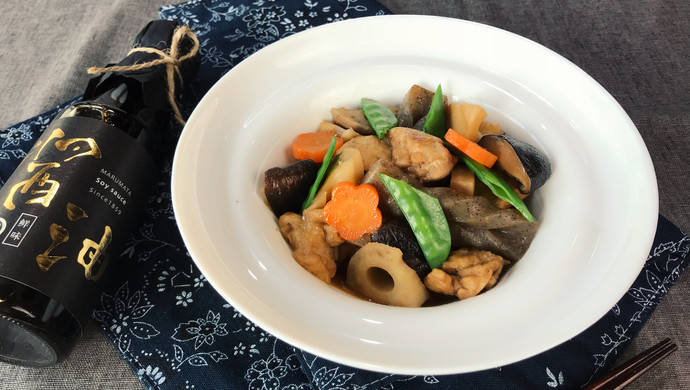
Japanese osechi cuisine Chikuzen stew
As soon as Christmas is over, the New Year is not far away! Every year, someone asks me how Japan celebrates the New Year? However, we are living a new calendar (the time and customs are different), but we also eat Chinese New Year’s Eve’s Eve~ In the past, when I was in a Chinese school, the teacher told us that we should not sweep the floor during the Chinese New Year, for fear of sweeping the blessings out! In fact, there is a similar New Year’s custom in Japan, we are not allowed to cook from the first to the third day of the first lunar month, for fear of disturbing the gods and bringing bad luck, so we will make New Year’s dishes before the New Year, that is, “osetsu cuisine”. What is interesting to many foreign friends is that the osechi cuisine is placed in a kind of layered triple box, which means happiness! And there are strict rules for what food should be placed on each floor: the first floor will put auspicious side dishes; the second floor will put the main dishes cooked by barbecue; The third layer is for dishes that have been heated and cooked with water. The quick dish I’m going to make today is usually “Chikuzen-sown” on the third floor, which originated in Fukuoka, Kyushu, and is locally called “kame-simmer” (甔煮), and is now one of the most common home-cooked dishes in Japan. Chikuzen stew is a slow-cooked dish that can retain most of the original flavor of the ingredients, sometimes Chinese friends say that we eat very originally, but its practical and simplest way to process the ingredients can restore the taste of the ingredients themselves. Therefore, this Chikuzen stew only uses two seasonings, umami soy sauce and mirin, which is simple and delicious. In addition to making vegetarian dishes with lotus root, shiitake mushrooms, radish, konjac, etc., you can also add some meat to your liking to enrich the variety of Chikuzen-simmered dishes. At the beginning of this month, I was a teacher in the cooking classroom of Shanghai City Supermarket, and the ingredients blended with each other but did not conflict, and the entrance levels were rich, and even some students who usually eat heavy food were amazed by Chikuzen stew. Here I secretly tell you that “lotus root” has a very auspicious meaning, because there is a hole in the middle that people can see through at a glance, so it also represents the good outlook and expectations for the coming year. It is a dish that is perfect for eating in the New Year of 2026.
Japanese Chikuzen cooking method
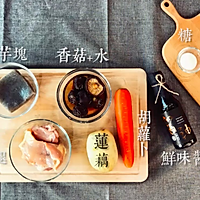
Step 1
Prepare the ingredients: see illustration.
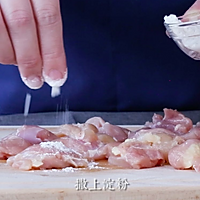
Step 2
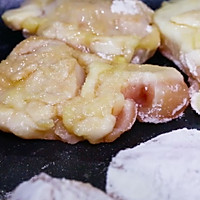
After cutting the chicken, let each piece be evenly sprinkled with starch.
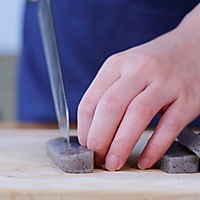
Step 3
Cut the konjac pieces into equal parts, then make a cut in the middle of each slice (note that both sides cannot be cut), then turn both sides out from the middle, twist the konjac pieces into a twist shape, and finally put them in boiling water and cook for 1 minute!
Step 4
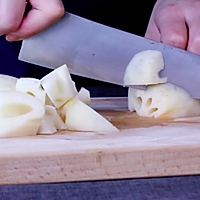
Cut the soaked shiitake mushrooms in half and cut the lotus root into pieces.
Step 5
Pour sesame oil into the pan, add the chicken and fry for 2 minutes, then turn over and fry for another 2 minutes.
Step 6
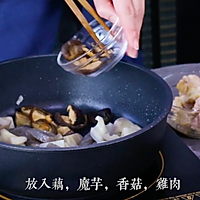
Add lotus root, konjac, shiitake mushrooms, and chicken.
Step 7
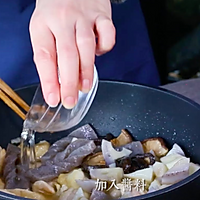
Pour in mirin, water, and fresh umami soy sauce, then boil until it boils and turn to low heat.
Step 8
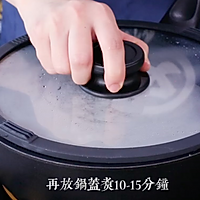
Take a kitchen paper towel completely dampened to make a “drop lid” to cover the ingredients in the pot, which can speed up the cooking time and make the ingredients taste faster! Finally, cover the pot and cook for 10~15 minutes.
Step 9
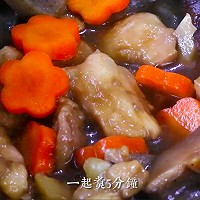
While waiting, slice the carrot and use a die to print the shape of the flower, pick up the “falling lid” in the pot, put the radish in and cook together for 5 minutes, and then you can start the pot and put it on a plate!
Step 10
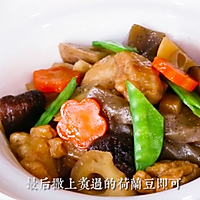
After each bowl is ready, you can add some green vegetables like snow peas at the end, and you’re done!
Step 11
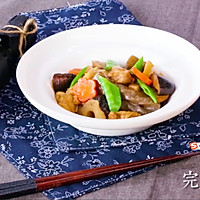
Complete diagram.
Cooking techniques for Japanese Chikuzen stew
In Japanese cuisine, there is often a cooking technique called “dropping the lid”, which is to use a lid smaller than the surface of the pot and cover the ingredients directly on the ingredients, in order to prevent the ingredients from rolling over, and also to allow the seasoning to quickly penetrate into the ingredients.